PR, Press Releases

SouthNEXT: A festival for the collision of art and technology celebrates four years

 Social Media Press Release

FOR IMMEDIATE RELEASE

November 9, 2018


Contact: Stephen Schnall

Email: sschnall@southorange.org

  • SouthNext’18 will take place from Nov. 10 to 11
  • According to Stephen Schnall, the founder and producer of SouthNEXT, tickets are FREE for Seton Hall personnel
  • Wristbands for all other attendees are $20
  • Sponsors: Saint Barnabas Medical Center/RWJBarnabas Health, Seton Hall University, The Township of South Orange Village, South Orange Performing Arts Center (SOPAC), Stop & Shop, South Orange Village Center.

Now in its fourth year, the SouthNEXT Festival will celebrate the current state of art and technology and look ahead to the future, exploring how the two collide. SouthNext will run from Saturday, Nov. 10 to Sunday, Nov. 11. The first day’s events will be held at SOPAC with the second day at Seton Hall University.

According to SouthNEXT’s founder and producer Stephen Schnall, the Festival is taking a different perspective this year as compared to years past. He said Seton Hall and it’s students will play a larger role in the event.

SouthNext (2)
Photo via Facebook/SouthNEXT

“Seton Hall has a much larger role in that the expectation is that half of the venues, performers, and attendees come from the school this year,” he explained.

He went on to say that the closing session “Mindfulness in the Community, What comes NEXT” will feature residents from South Orange and Maplewood, a SHU religion professor and two student representatives from the “Concerned 44.”

He added that tickets are free for all Seton Hall personnel, including students. All attendees have to do is click the “Get  Tickets“ button on the website and pick the SHU option. Other participants will need a $20 wristband for entry.

Schnall said that this year’s themes will include mindfulness, technology, community engagement and inspiration. These ideas, he said, will be apparent in all sessions and activities throughout the weekend. For example, attendees will have the opportunity to participate in an interactive mural on Saturday, from 12 to 6 p.m. According to the SouthNEXT website, the mural is comprised of colorful and movable pieces with which people can come together and create what inspires them. The activity will be led by Elina Rosenblum, founder of BlumArts LLC. The website explained Rosenblum’s connection to the artistic community.

“Her curiosity in applying herself to different forms of arts pushes her to experiment, generate tons of ideas and seek creative solutions,” the statement read. “Her desire is to bring beauty and joy to the world by transforming public or homely spaces from dull into delightful with the benefits of color therapy.”

This is just one example of the insightful people and engaging activities attendees will encounter at SouthNext’18!

According to the Festival’s “About” page, SouthNEXT aims to bring the diverse community of South Orange together for the exchange of ideas. One aspect of this is challenging people’s beliefs about what is possible. However, recognizing unity and the “collision” of interests is important to event organizers.

DISCLAIMER: This press release is for a class assignment for my COJR 3422 course at Seton Hall University.




Change, Journalism, PR

A new way to think about news releases

According to PR News, the format and delivery of news releases is changing. What was once thought of as a useful tool to  disseminate important updates or a public statement is now much more. The article explains that news releases should be put out often, essentially following any company update and they should be interactive. This includes a multimedia approach with links to related content, audio, video or images.

The new way of looking at news releases coincides with the popularity of the Internet. More and more people consume of the news through this medium. In fact, as of August 2017, the Pew Research Center reported that 43 percent of American adults often get their news online.

news release post photo
Photo via Unsplash/andrewtneel

The multimedia aspect shows the way in which web content broadens the possibilities of news coverage. Take, for example, a New York Times video on the New York transit system. Here, one can see an organization that is perhaps best known for its print content, producing a video that contains text, references to other material, audio and fast-paced editing. If viewers wanted, they could click off and do independent research based on the people and facts referenced. Also, the pacing and some of the stylistic choices would make it appear as though the Times is targeting the younger audience finding its news on the web.

Since the nature of the Internet is such that it is updated constantly with new content, public relations professionals need to keep the flow of new information about a product or brand going at a consistent rate. Otherwise, there is a danger there that the brand has become “old news” and not worth the audience’s attention.

A final important way to engage the audience is by allowing them to engage with the content. Other than links to follow, many readers would likely enjoy being a part of the conversation.  The article, video or press release functions as a diving board. Now, let them jump in and give their opinions. This can be accomplished in a variety of ways, either by adding a comments section to the piece or website or providing contact information to whom readers can voice their questions, concerns and thoughts.

News releases are no longer disseminated to the public solely at the discretion of an editor publisher. The web allows for direct access to these important updates. As I have said in many of my past posts, the audience is fast becoming the journalist. That also means an added layer of responsibility to decide what is news.

Change, Debated Topics

The process of live tweeting #QuestionsOnKavanaugh

Before Judge Brett Kavanaugh’s confirmation to the U.S. Supreme Court, I worked with my classmate, Samantha Todd, to get students’ thoughts on the hearings, sexual misconduct allegations and FBI investigations that surrounded this moment in history.

While live tweeting, we used the hashtag #QuestionsOnKavanaugh. We believe that the hashtag has two benefits. One, it is short and has sound repetition with the first and last word, making it easier to remember. Two, it quite literally describes the event, as we were asking students our “Questions on Kavanaugh.”
Statue

We gathered opinions on the basis of three questions. First, we connected Kavanaugh’s political history to the controversy surrounding further FBI investigation into his life.

The question read: “The FBI is looking into the sexual misconduct allegations against Judge Brett Kavanaugh. The White House has authorized the FBI to interview anyone the FBI thinks is necessary. Kavanaugh served in the George W. Bush White House. Over the course of his career in the federal government, Kavanaugh has undergone six background checks. The FBI has previously done a background check on him as part of the White House’s review process of vetting him for the Supreme Court. Do you think it’s necessary for the FBI to investigate Kavanaugh again? Why or why not?”

We asked this question, in large part, to add context to the debate. I’m unashamed, even as a journalism major, to admit that I knew little about Kavanaugh’s past before the U.S. Senate hearings. We did not want to assume that students knew everything there was to know about the judge before going into this discussion. Whether or not Kavanaugh should undergo another FBI investigation was a major question leading up to his confirmation. Therefore, we wanted to know what students thought about it.

The four students interviewed all agreed that the FBI should proceed with another check into  Kavanaugh’s past. Students said, if the FBI did not investigate, they would be less trusting of Kavanaugh.

“I think it would be very reassuring for the country if another investigation was launched,” said Liam, a sophomore public relations major.

We followed that question by asking, “Do you think Kavanaugh should be nominated to the Supreme Court. Why or why not?”

We asked this question because, after providing context, we wanted to give students an opportunity to take part in the dialogue or the central question. Three out of four of the students seemed to agree that, in that question, there were many aspects to consider. Ultimately, they said, the findings of the Senate and FBI would determine their answer.

Veronica, a senior creative writing major, expressed her mixed feelings on the topic. “How do I have faith in a justice system if I don’t trust one of the highest powers,” she said. “But, at the same time, if he’s innocent, then I feel bad.”

Thomas, a junior history major, said Kavanaugh should not be confirmed because, in the wake of these allegations, Kavanaugh’s credibility is damaged in the eyes of many Americans. He explained that Kavanaugh’s confirmation would, in turn, change the way people view the Supreme Court for the worse.

Lastly, we asked students if they believed the Senate would proceed with Kavanaugh’s confirmation. We ask this because we wanted students to look ahead to the future, take all the components we talked about and reach a final conclusion.

Again, three of the four interviewees said the Senate was likely to push Kavanaugh through, as he had both Trump and Republican Party backing.

Even though Kavanaugh is now officially a justice of the Supreme Court, his confirmation is meeting continual backlash. I regularly see pictures of protesters’ signs on social media as they display their discontent around D.C.

Our interviews provided a sample of beliefs on the issue in an attempt to make sense of this contentious time.

Blogging, Journalism, PR, Social Media

Twitter: A useful tool or the downfall of journalism and PR?

Okay, admittedly, the title of this week’s post is a bit dramatic and also implies that there is a clear answer. Ultimately, I land somewhere in the middle.

Twitter has its uses, both for journalism and PR. As Forbes suggests, PR professionals can use the platform for announcements, news releases and contest launches among other tactics. In a 2012 post, the late Steve Buttry laid out 10 reasons why journalists should be on Twitter, all of which seem valid. I particularly identified with his top reason, finding breaking news. As Campus Life Editor for Seton Hall University’s The Setonian, I routinely look for stories on social media. 

However, to put it bluntly, there is a risk of getting caught up in the platform and becoming lazy. Based on experience, I can more easily relate to how this affects journalism as opposed to PR. Most journalists cite Twitter as a key place to look for sources. Many articles even have embedded tweets in them as a means of gauging public response to news.  However, according to the Canadian Broadcasting Corporation (CBC) many accounts on Twitter are in fact bots and not real people.

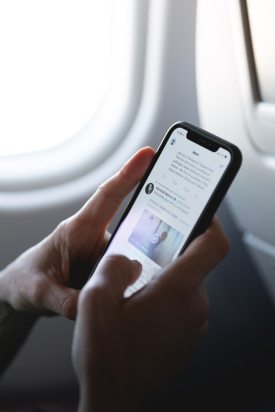
Twitter pic
Photo via Unsplash/Marten Bjork

There is a way to check on this. For example, running account name through Botometer can help determine if the account is real or not.  Since bots are usually designed to participate and share in the spread of propagandized information, a journalist who does not verify his or her source could unwittingly be aiding in this goal.

However, if a journalist or PR professional is careful about their source aggregation, Twitter can doubtlessly be a useful tool. Individuals in both professions can find a litany of ways to gain followers and spread their messages and stories. One way to gain followers on Twitter is to add your name to a directory, as per the Forbes article. If  people want information on a certain topic, you can be listed as a go-to source. If the content is engaging enough, you will likely have yourself a new follower. Forbes also mentions the benefit of adding a twitter widget to your blog, like the one on mine. If you regularly keep your Twitter account updated with regard to upcoming posts and news, visitors to the blog will see that and may follow you to keep updated.

Even though, at the outset of this post, I said I landed somewhere in the middle on Twitter being a must or not for journalism and PR, I will conclude by saying that there are far too many benefits to the platform to ignore it completely. Another way to look at the fields I just mentioned is to point out that they both involve communication. Social media, whether it be Twitter; Facebook; Instagram or whatever platform to be introduced in the years to come, has become the way billions across the globe communicate and connect. To ignore this change is to be in the dark when it comes to the media industry.

On that note, for the latest on what is happening with Julie’s Corner be sure to follow me on Twitter at @SHUSocialJulie.  If you’re interested to learn more about what’s happening at Seton Hall, check out the blog I run with a classmate, Campus Rundown! We can be reached at @CampusRundown.